


If you engineered a better engine, manufactured more efficiently, delivered superior reliability, or created a stronger Dealer network, you won. The companies that mastered those disciplines became household names and industrial giants. Ford transformed manufacturing. General Motors mastered scale. Toyota perfected operational excellence. Mercedes-Benz sold engineering. BMW sold performance. Honda sold trust. The winners built better cars.
Yet, we are now at a turning point.
For the first time in automotive history, the focus of competitive advantage is shifting from the vehicle itself to the broader system that enables and supports it. Although this idea may challenge long-standing industry conventions focused on the product, mounting evidence suggests that integrated ecosystems of technology, infrastructure, and data are now more critical determinants of success.
Consumers still buy vehicles, but the competitive advantage behind those vehicles is shifting elsewhere:
Batteries matter more than engines.
Software matters more than horsepower.
Data matters more than sheet metal.
The economics of mobility are shifting away from the vehicle itself and toward the surrounding ecosystem that enables its operation. For instance, firms like BYD and Tesla have demonstrated that controlling elements such as the battery supply chain, proprietary software platforms, charging infrastructure, and extensive data networks lead to significant cost advantages and market agility. As these examples illustrate, the next decade is likely to favor the company that successfully coordinates and dominates not only vehicle production but also the battery supply chain, software stack, data layer, energy infrastructure, autonomy platform, financing ecosystem, and customer relationships that persist beyond the initial sale.
This shift redefines who has the advantage.
China’s System vs. The West’s Product
The biggest threat facing Western automakers is not that China has learned how to build electric vehicles. It was China that taught us how to build the entire system.
For years, much of the automotive industry treated EVs as a product category. China treated them as part of its national industrial strategy. While Western manufacturers debated consumer demand, charging adoption, Dealer readiness, and regulatory timelines, China spent two decades investing across every layer of the future value chain:
Battery production
Rare earth processing
Charging infrastructure
Semiconductor manufacturing
Software development
Supply chain resilience
The result is that Chinese manufacturers are not simply competing on vehicles. They are competing in economics.
Anyone can eventually build a competitive electric vehicle. Building an industrial ecosystem capable of producing millions of vehicles profitably is far more difficult. For example, BYD not only manufactures its own batteries but also operates its own supply chains, develops proprietary software, and manages raw materials sourcing—all under one roof. This integrated approach allows BYD to control costs, optimize production, and scale rapidly, making it much harder for competitors to match its economics.
BYD: The Battery Company Mimicking Henry Ford
This approach is why BYD may become one of the most important companies in automotive history. Most people still view BYD as an automaker, but that is the wrong lens through which to view it.
BYD is a battery company that expanded into vehicles.
That sounds like a subtle difference. It isn’t. Batteries represent the largest cost component in an EV. They influence range, profitability, manufacturing economics, supply chain security, and ultimately pricing power. By controlling the battery layer, BYD positioned itself at the center of the EV economy before most competitors even understood where value would accrue.
Today, the company operates with a level of vertical integration that would make Henry Ford smile. Batteries, electronics, software, manufacturing, and vehicle production increasingly live inside the same ecosystem.
The automotive industry celebrates product innovation, but history tends to reward system innovation. Those are not always the same thing.
Tesla’s Evolution Beyond the Car
Which brings us to Tesla. Much of the conversation surrounding Tesla focuses on market share. Some analysts argue that Tesla’s innovative ecosystem gives it an enduring advantage. In contrast, others contend that intensifying global competition—particularly from BYD and other Chinese manufacturers—poses a significant threat to Tesla’s position. Key questions remain: Can Tesla effectively compete with BYD, withstand Chinese pricing pressure, and respond to new entrants seeking to erode its lead?
Those questions miss a more important point:
Tesla’s future likely depends on becoming less of a car company.
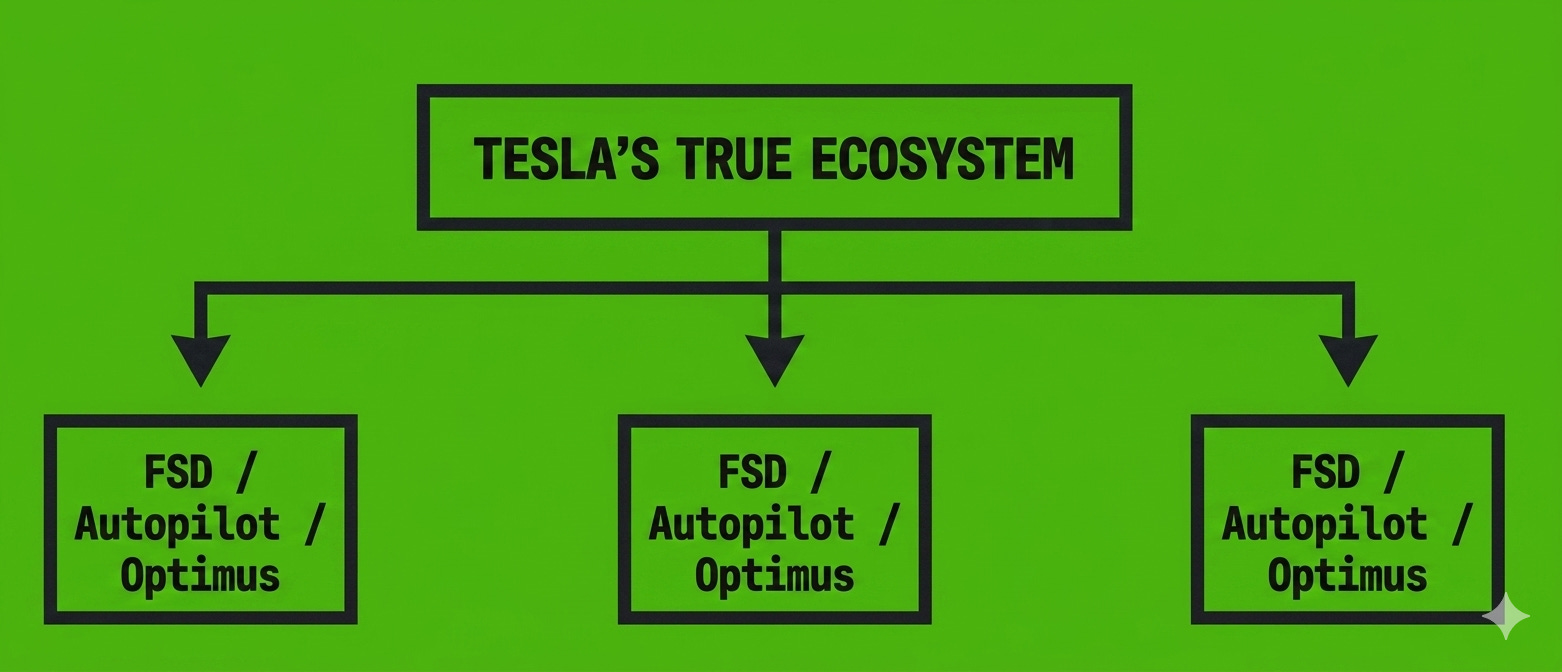
If Tesla remains primarily a manufacturer, it will eventually face the same forces confronting every automaker: margin compression, product cycles, and relentless competition. If Tesla successfully evolves into a mobility platform, the conversation changes entirely.
No company outside China combines Tesla’s assets: charging infrastructure, connected-vehicle data, software deployment, energy storage, AI, and an autonomous-driving platform on the same scale. Tesla’s future competitiveness will not depend on how many vehicles it sells, but on its ability to monetize the ecosystem around those vehicles by leveraging its infrastructure, software, and data to generate revenue streams far beyond traditional car sales. Success for Tesla will mean transforming into a mobility and energy ecosystem company, which is a fundamentally different and more defensible business model than a car manufacturer alone.
For traditional automakers, the lesson is clear: future advantage will depend less on vehicle innovation and more on building integrated systems and platforms that capture value throughout the ownership journey. Recent developments in the industry, such as BYD’s success in vertically integrating battery manufacturing, software development, and supply chain operations, and Tesla’s ability to monetize its charging infrastructure and data-driven services, provide concrete examples of how these strategies translate into competitive advantages. Incumbents should therefore focus on developing digital capabilities, forging strategic partnerships, and investing in data, software, and infrastructure layers beyond the car itself, to remain relevant as the industry evolves. Those who adapt by building and monetizing their own ecosystems, as demonstrated by these leading firms, will be better positioned to compete and grow in the new automotive landscape.
The Incumbent Dilemma & The Dark Horses
The same challenge exists for the traditional automakers, but in a different form. Ford, General Motors, and Stellantis find themselves trapped between two realities:
The future demands transformation, but the present still pays extraordinarily well.
Their most profitable products remain trucks, commercial vehicles, financing portfolios, and the service infrastructure that supports them. Every dollar invested in the future risks disrupting the economics that fund the present. This phenomenon is the innovator’s dilemma at an industrial scale. History shows that incumbents rarely fail because they lack resources; they fail because their existing business models remain too profitable to abandon.
Toyota’s Straight-Line Skepticism
This reality explains why Toyota has become one of the most misunderstood companies in the automotive industry. For years, critics argued that Toyota was falling behind because it refused to embrace the industry’s EV narrative fully.
Yet Toyota appeared to recognize something others overlooked: technological transitions rarely happen in straight lines. Consumers do not adopt technologies because analysts want them to. They adopt technologies when economics, infrastructure, convenience, and trust align. Toyota continued investing heavily in hybrids while much of the industry raced toward all-electric futures. In hindsight, that strategy appears far more disciplined than many critics initially believed.
The lesson for executives is clear: lasting competitive advantage comes from disciplined, market-driven transitions rather than chasing industry narratives or hype cycles. Staying closely attuned to market realities, investing selectively, and ensuring readiness for multiple scenarios can be more effective than forced transformations. Strategic patience and a willingness to challenge industry momentum are essential qualities for leading through disruption. Looking ahead, those executives who cultivate organizational flexibility and continuously integrate emerging technologies are the best positioned to anticipate and shape the next wave of industry transformation.
The Hyundai-Kia Dark Horse
If there is a true dark horse in the global automotive race, it may be Hyundai and Kia. Quietly, consistently, and without much fanfare, they have transformed themselves into legitimate technology competitors.
Their EV products are increasingly compelling. Their design language is among the strongest in the industry. Their willingness to challenge conventional assumptions has allowed them to move faster than many legacy competitors. Most importantly, they appear comfortable disrupting themselves, a mindset that becomes increasingly valuable during periods of industry transition.
The New Rules of the Game
Which brings us back to the central question: Who wins?
The answer may be neither the company with the best vehicle nor the one with the most vehicles. The winners of the next decade will likely be those who control the layers surrounding the vehicle itself:
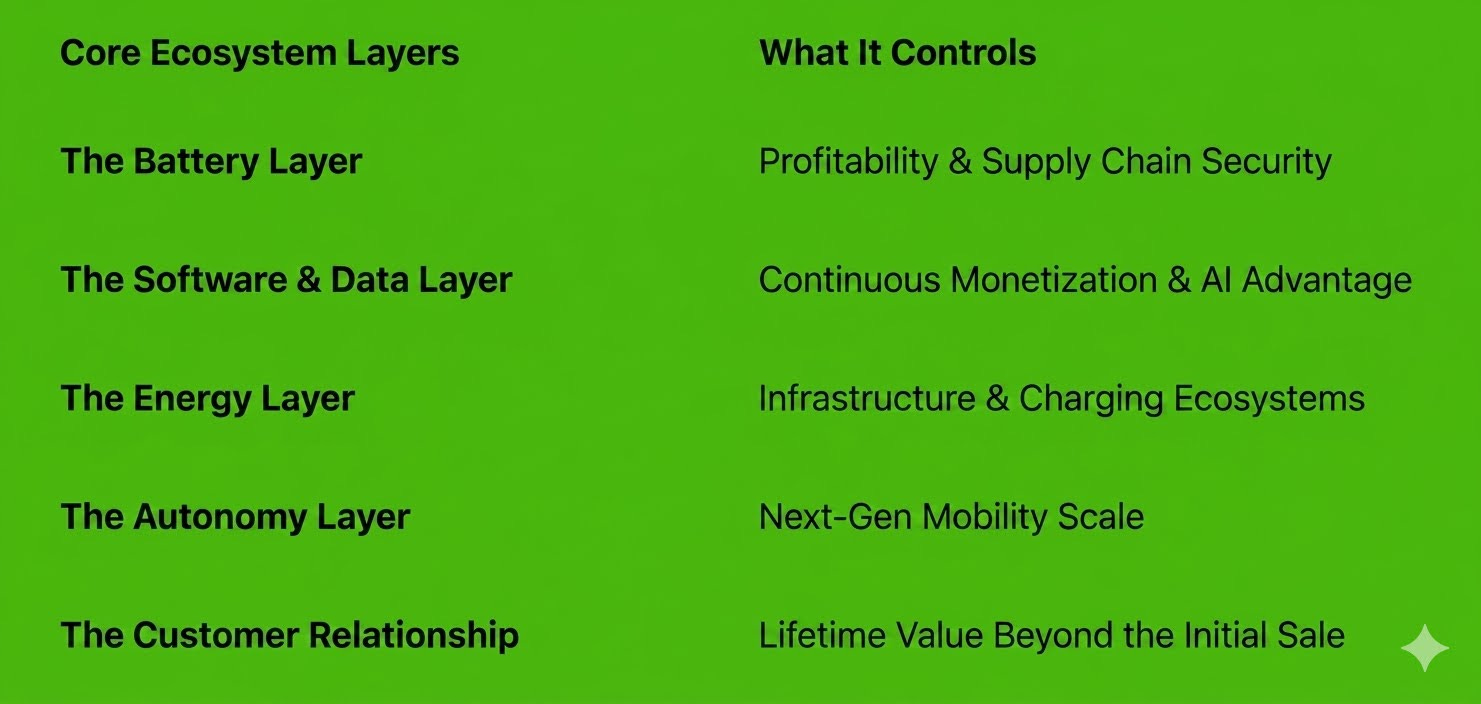
For more than a hundred years, the car was the product. Increasingly, the car is becoming the endpoint, as value creation shifts toward the broader system surrounding the vehicle. The real product is now the ecosystem. The companies that recognize and strategically embrace this transition will define the next chapter of automotive history. Ultimately, the future of the industry will be shaped by those organizations that synthesize product excellence with comprehensive ecosystem integration, positioning themselves to succeed as the sector evolves toward an interconnected, platform-driven model.