


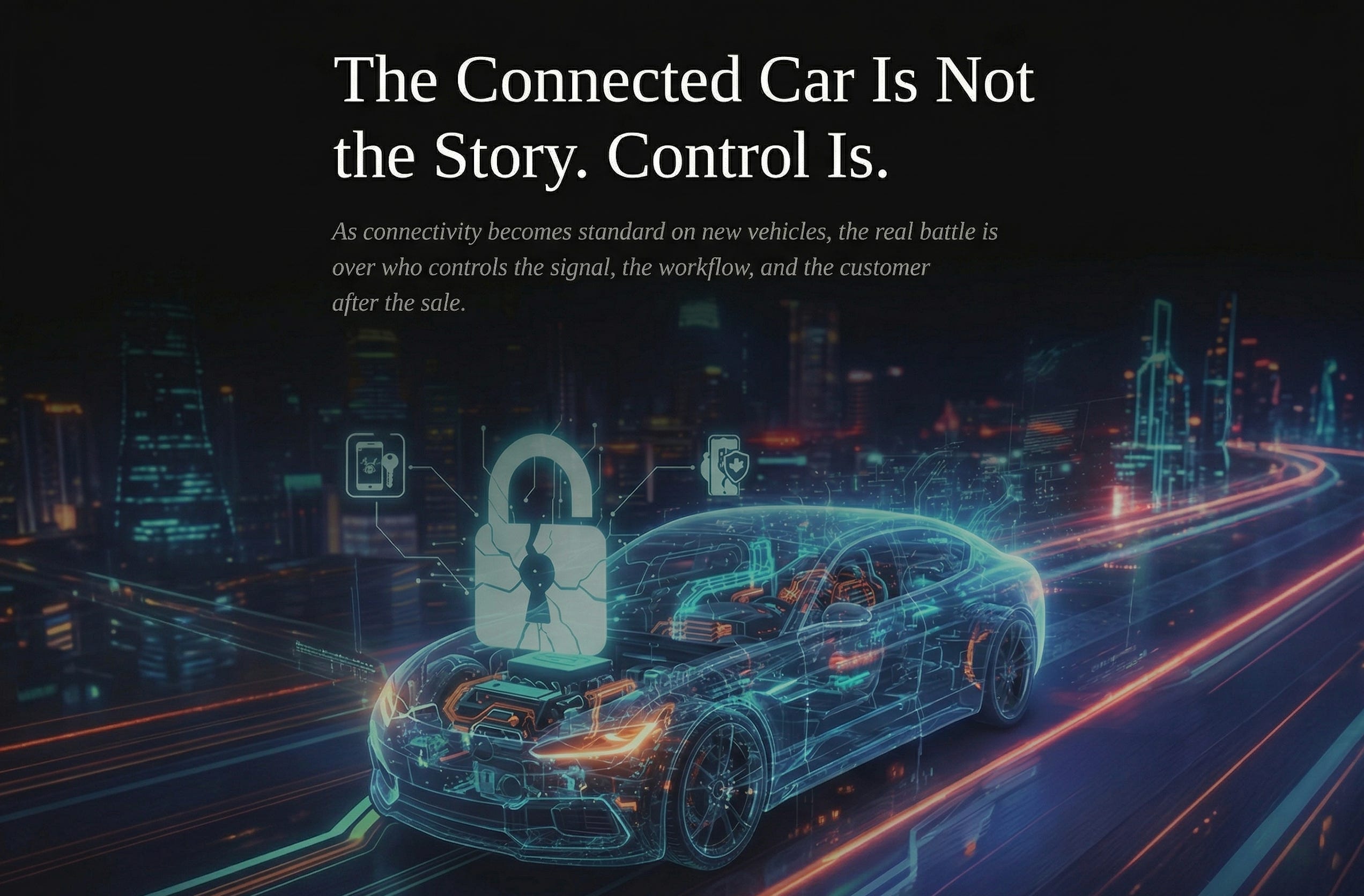
Recent advancements in automotive technology have established vehicle connectivity as a standard feature in new cars, fundamentally altering the industry's central axis of competition. The critical issue is no longer the technological sophistication of connected vehicles, but rather who retains control over the ongoing connected relationship between the customer, vehicle, and Dealer.
Within the next few years, “connected vehicle” will stop being a differentiator and become baseline market infrastructure. McKinsey has projected that more than 90 percent of vehicles sold in 2030 will be connected, while Berg Insight’s more recent market forecast estimates that embedded OEM telematics attach rates will rise from about 79 percent in 2024 to 93 percent in 2029, with connected-car subscriptions growing from 286.6 million to 528.1 million in that same period. (Bertoncello et al., 2024)
The strategic question for Dealers is no longer about data transmission. Instead, it is about who owns the signal, controls the workflow, and determines the next-best action after the vehicle is sold. This distinction is beginning to divide the market.
Some OEMs use connectivity to maintain the Dealer as a key part of the ownership lifecycle. Others are shifting the Dealer further downstream in connected-service environments, away from the core intelligence layer.
This distinction is important because connectivity alone does not generate Dealer value. Dealer value arises when vehicle health signals, maintenance alerts, and service workflows are routed through systems that keep the retailer connected to both the consumer and the vehicle. Without this, the Dealer risks becoming merely a fulfillment endpoint within an OEM-controlled system.
Ford exemplifies a dealer-aware model, which is significant because it demonstrates how connectivity can be structured to preserve and enhance the Dealer’s role in the ownership lifecycle. Its owner experience allows customers to select a preferred Ford Dealer and schedule service through the Ford app. Ford Live materials state that Dealers can access connected-vehicle data after customer contact to advise on servicing and pre-diagnose issues before the vehicle arrives. By routing telematics data directly to Dealer execution, Ford ensures that Dealers remain active participants in the value chain, fostering stronger customer relationships and enabling more efficient, targeted service interventions. (Ford Pro Telematics Live GPS Data Helps Dealership Protect Fleet, 2024)
GM offers similar infrastructure, but its approach is more OEM-centric. Public support materials show vehicle status, diagnostics, and preferred-dealer service flows within the MyGM and OnStar environments. While Dealers are involved, the orchestration layer remains closely integrated with the OEM account structure rather than a dealer-protective model. (OnStar Dealer Maintenance Notification Info, 2014)
This difference is significant, not subtle.
In fixed operations, outreach economics depend on signal quality. Without reliable telematics, service marketing relies on unreliable mileage estimates, generic intervals, outdated ownership records, and incentive-heavy campaigns to offset poor timing, eroding margins. Improved signal quality changes this situation: messaging becomes precise, service reminders are event-driven, appointment conversion increases, and over-couponing declines as outreach matches actual needs.
The import brands make this even clearer.
Toyota provides a strong example of dealer-protective design. Maintenance notifications and vehicle alerts can be sent to both the customer and the preferred Dealer if the customer opts in to Service Connect communications. Service scheduling through the app is also centered on the preferred Toyota Dealer. This is a fundamentally different approach from a generic owner app with only a Dealer locator. (Toyota App, 2024)
Volkswagen is even more explicit. VW’s U.S. terms state that certain information, including the Vehicle Health Report, will be shared with the preferred Dealer unless the customer opts out through the myVW app. VW also uses Vehicle Health Reports to identify when a vehicle may require a check-up at the local Volkswagen Dealer. This is one of the clearest public statements supporting the routing of connected-vehicle value to the retail network. (myVW App - Vehicle Health Reports, 2024)
Subaru is more dealer-oriented than often recognized. Its connected-services materials state that service reminders can be sent to the vehicle and app when it is time to schedule maintenance at the customer’s chosen retailer. The MySubaru experience also includes system health information and visibility into vehicle condition. Subaru connects ownership to retailer-directed service, not just remote convenience. (MySubaru Connected Services | In-Vehicle and Mobile Technology, 2024)
Hyundai and Kia also demonstrate strong dealer-aware service design. Hyundai’s vehicle-health system centers on the preferred service Dealer and links health reporting to Dealer scheduling. Kia’s owner materials combine monthly health reports with preferred-dealer selection, service scheduling, and coupons. This approach creates a service funnel rather than just an owner dashboard. (Monthly Vehicle Health Report, 2024)
Mazda is a noteworthy but often overlooked case. Vehicle Health Report information can be accessed by Dealers or the Customer Experience Center through the connected services system, and the MyMazda experience includes service scheduling, reminders, and dealer-provided service offers. Mazda uses connectivity to support maintenance conversations backed by retail execution. (Connected Service Manual, 2024)
BMW takes a different approach. Its TeleService capability transmits vehicle status and service needs directly to the BMW Center, enabling a representative to contact the customer to schedule an appointment. While the Dealer remains involved in the service process, this model prioritizes BMW’s central brand control over the customer relationship and signal flow. The implication of this account-centric design is that BMW, rather than the Dealer, retains primary ownership of the customer interface and service orchestration. This approach may limit the Dealer’s ability to build direct customer relationships and leverage connectivity to deliver differentiated service value, unlike the dealer-protective frameworks implemented by Toyota or Volkswagen.
While connectivity is rapidly becoming a ubiquitous feature in the automotive industry, the extent of Dealer influence over connected relationships remains a pivotal and unresolved issue. The analysis demonstrates that OEMs adopting dealer-protective connectivity models may enable Dealers to sustain meaningful roles in the ownership lifecycle, enhancing service value and customer retention. Conversely, OEM-centric models risk diminishing Dealer relevance by centralizing control of customer data and service orchestration. Thus, the way OEMs structure connected relationships will considerably affect not only industry competition but also the strategic positioning of Dealers, ultimately shaping the broader evolution of the automotive market.
Every major brand now offers vehicle status, diagnostics, remote services, OTA support, health reporting, or app-based scheduling. These features are no longer differentiators. (2024 U.S. OEM ICE App Report, 2024) The true differentiator is whether the OEM has structured the ownership experience to maintain Dealer relevance after the sale. Dealers should shift from viewing connectivity as a feature to considering it as a matter of control over the customer relationship.
The relevant questions have changed:
Does the customer designate a preferred Dealer, or is the customer automatically assigned to the selling Dealer?
Do maintenance alerts and vehicle-health signals flow to the selling Dealer or consumers ch’s choice?
Can the Dealer act on the signal to make their messaging deterministic?
Does the connected workflow preserve the Dealer’s role in retention, service conversion, and customer communication?
Or does the OEM own the app, the identity, the prompt, the diagnostic layer, and the next action, while the Dealer simply fulfills the transaction?
This is the primary divide emerging in the market, and a conversation that is becoming increasingly important for Dealers.
When a Dealer stays connected to both the consumer and the vehicle, new use cases emerge. Fixed operations retention improves, service demand becomes more predictable, and couponing becomes more targeted to actual needs. Over time, this connectivity can also enable more effective F&I positioning, particularly for EVs and hybrids, where vehicle health informs extended coverage, service contracts, and lifecycle offers.
The connected car itself is not the main issue; control of the connected relationship is. Cars will be connected regardless. The key question is whether they remain connected to the Dealer that sold them.
References
Bertoncello, M., Martens, C., Möller, T. & Schneiderbauer, T. (2024). Car connectivity: What consumers want and are willing to pay. McKinsey. https://www.mckinsey.com/industries/automotive-and-assembly/our-insights/car-connectivity-what-consumers-want-and-are-willing-to-pay
(November 11, 2024). Ford Pro Telematics Live GPS Data Helps Dealerships Protect Their Fleets. Ford Motor Company. https://www.fromtheroad.ford.com/us/en/articles/2024/ford-pro-telematics-live-gps-data-helps-dealership-protect-fleet
(2014). OnStar Dealer Maintenance Notification Info. GM Authority. https://gmauthority.com/blog/gm/general-motors-technology/onstar/onstar-dealer-maintenance-notification-dmn/
(2024). myVW App - Vehicle Health Reports. Volkswagen of America. https://www.vw.com/en/owners-and-services/connectivity-and-apps/myvw-app.html/__layer/layers/myvwportal/myvw_app/s137/vehicle-health-and-maintenance/master.layer
Who owns the signal? Who controls the workflow? Who determines the next action when that vehicle needs service? And critically, whether that next action routes to the selling Dealer or around them.