


Q2 2026 earnings season is done for the seven publicly traded US retail auto dealer groups, and if you only look at the top line, the sector looks fine. Lithia & Driveway grew revenue 2.2%. Sonic Automotive grew 7.6%. Penske grew 6.0%. CarMax grew 6.2%. Even Asbury eked out a small gain. Only AutoNation and Group 1 saw revenue decline.
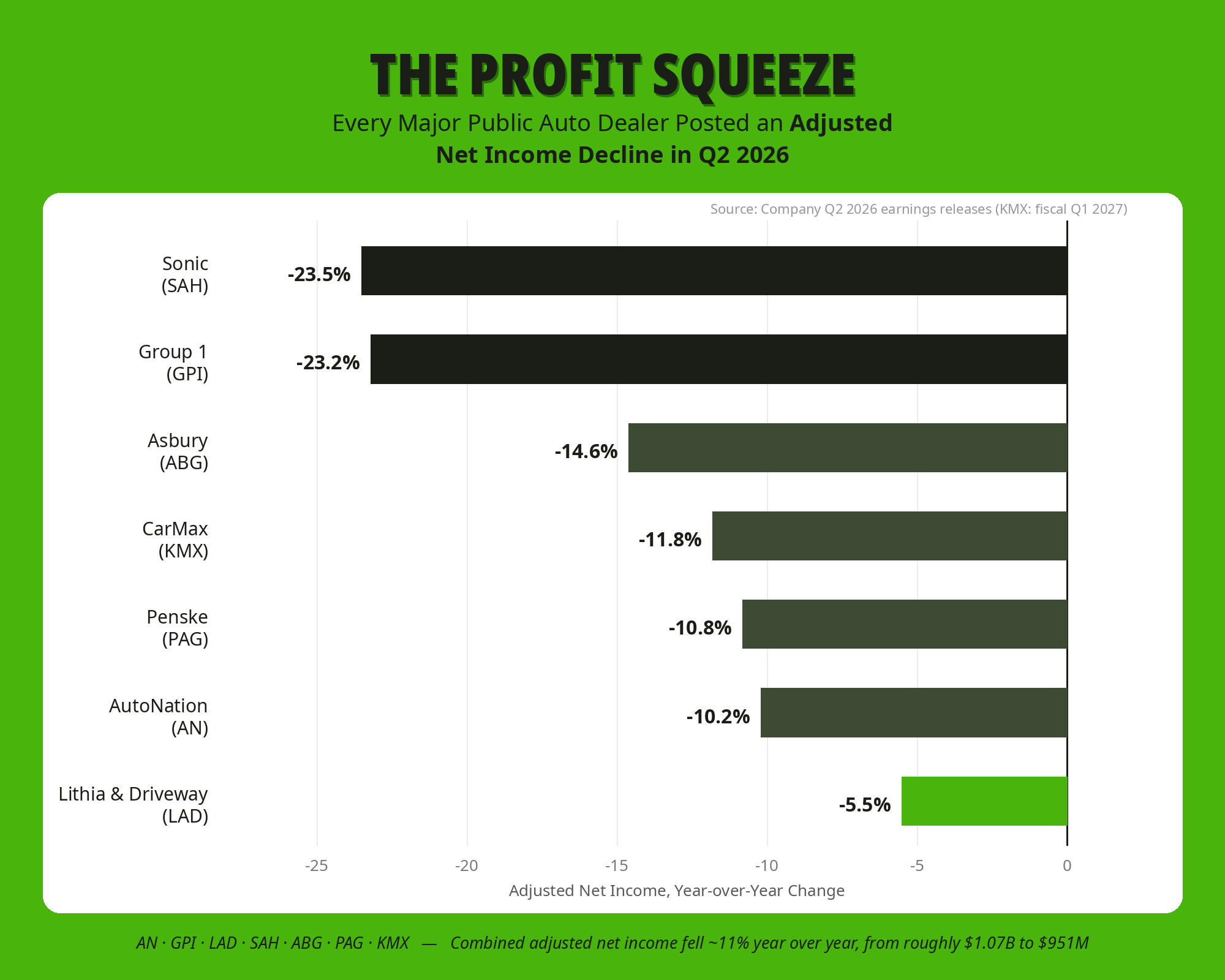
But look one line down the income statement, and the story flips completely. Every single one of these seven companies posted a decline in adjusted net income year over year. Combined adjusted net income across the group fell roughly 11%, from about $1.07 billion to $951 million.
That’s not a demand problem. That’s a margin problem — and it’s the same margin problem across every business model in the peer group, from mass-market franchise networks to CarMax’s pure-play used-vehicle model.
The Spread Tells You Where the Pain Is Concentrated
Sonic Automotive (-23.5%) and Group 1 Automotive (-23.2%) took it the hardest. Asbury (-14.6%) and CarMax (-11.8%) sit in the middle. Penske (-10.8%) and AutoNation (-10.2%) landed close together. Lithia & Driveway (-5.5%) was the standout — the only company in the group that actually improved its GAAP SG&A-to-gross-profit ratio year over year, even as its floorplan interest expense jumped 26.7%.
Group 1’s number is worth sitting with. A same-store dealership rebranding effort disrupted search visibility and showroom traffic enough that management attributed roughly two-thirds of the same-store new-vehicle revenue decline to it — a self-inflicted, company-specific headwind stacked on top of the industry-wide compression everyone else is dealing with. The company responded with one of the more aggressive cost actions disclosed this cycle: about $50 million in annualized cost cuts and roughly 700 eliminated positions (Group 1 Automotive Q2 2026 press release).
The Real Driver Isn’t Revenue — It’s SG&A Leverage
Here’s the mechanism, and it’s consistent across every company I looked at: gross profit dollars are shrinking faster than SG&A can be cut. That’s it. That’s the whole story.
Every group in this set except Lithia (on a reported GAAP basis) saw its SG&A-to-gross-profit ratio deteriorate year over year — Asbury and Sonic worst of all, up roughly 400 and 370 basis points respectively. When a management team says “we’re targeting a 66-67% SG&A ratio by year-end” (AutoNation’s stated goal), what they’re really saying is: our cost base isn’t the problem, our gross profit denominator is shrinking under us, and we’re racing to cut fast enough to catch it.
New-vehicle gross profit per unit compression is the single biggest culprit. OEM incentive normalization plus softer affordability is squeezing transaction margins across the board, and it’s happening whether you’re AutoNation with a diversified premium-luxury mix, or Group 1 fighting company-specific headwinds on top of it.
Fixed Operations Is Doing the Heavy Lifting — For Now
If there’s one thing every single company called out as the profitability anchor this quarter, it’s parts & service — what the industry calls fixed operations or aftersales. Group 1 flagged that fixed ops was just 13% of Q2 revenue but delivered 45% of gross profit. Lithia’s aftersales business is its single largest gross-profit contributor at 42% of the total. Sonic posted a record for its franchised-dealership parts & service gross profit even as vehicle-sale margins fell.
This isn’t new — fixed ops has been the quiet backbone of dealer profitability for years — but its relative importance is climbing every quarter that new- and used-vehicle margins keep compressing. The question I’d be asking as an operator or investor right now: how much more can fixed ops absorb before it hits a growth ceiling of its own? Service capacity, technician availability, and bay throughput are real physical constraints. You can’t infinitely scale your way out of a vehicle-sale margin problem with a service department that’s already running near capacity in a lot of markets.
Captive Finance and Insurance Units Are Quietly Reshaping Reported Earnings
A detail that deserves more attention than it’s getting: the captive finance and insurance-adjacent businesses embedded inside these dealer groups are starting to move GAAP earnings in ways that have nothing to do with underlying vehicle economics.
Asbury’s Total Care Auto — its captive vehicle-service-contract and insurance-product subsidiary — booked a non-cash revenue-deferral effect that cut adjusted EPS by $0.66 per share this quarter alone. Strip that out and Asbury’s adjusted EPS would have been $7.48 instead of the reported $6.82 (Fortune, Asbury Q2 2026 earnings call transcript). That’s a purely accounting-driven swing, not a reflection of how the underlying business performed. AutoNation Finance and CarMax Auto Finance are playing similar, if less dramatic, roles — CAF’s loan penetration climbed to 43.3% of retail units this quarter, and its interest margin actually expanded 20 basis points even as the used-vehicle retail side saw per-unit gross profit fall $230 (CarMax Q1 FY2027 press release).
The takeaway for anyone modeling this sector: captive-finance and service-contract accounting increasingly needs to be pulled apart from core vehicle-sale gross profit before you draw conclusions about operating health.
M&A Hasn’t Slowed Down — If Anything, It’s Accelerating
What’s notable is that none of this margin pressure has put a brake on consolidation. Group 1’s pending acquisition of 10 Hennessy Automotive dealerships in Atlanta is expected to close by year-end and add roughly $1.7 billion in annual revenue — one of the largest single deals disclosed across the peer group this cycle. Penske deployed roughly $670 million toward acquisitions in the first half of 2026 alone, continuing its run of premium-brand dealership additions (Penske Automotive Q2 2026 SEC filing).
That’s a signal worth sitting with: even in a quarter where every company’s profitability fell, the largest operators are still leaning into scale as the answer. Bigger fixed-ops footprints, bigger F&I penetration pools, bigger captive-finance books. If margin compression is structural rather than cyclical, scale is the only lever left that reliably works.
What I’m Watching Into Q3
Three things, in order of how much they’ll actually move the needle:
Whether fixed ops keeps absorbing the shock, or whether service capacity constraints start showing up as a growth ceiling on the one segment everyone is leaning on.
Whether SG&A cuts catch up with gross profit, or whether this becomes a multi-quarter chase where cost actions permanently lag a shrinking denominator.
How much captive-finance and insurance-product accounting continues to distort headline EPS — Asbury’s TCA deferral this quarter is a preview of a dynamic that’s only going to get more material as these captive units scale.
The sector isn’t broken. But the easy years of vehicle-sale margin doing the heavy lifting are clearly over, and the winners from here are going to be the operators who can genuinely run fixed ops harder, cut SG&A faster than gross profit falls, and use their captive-finance books as a real profit center rather than an accounting curiosity.
Data and analysis drawn from Q2 2026 earnings releases and SEC filings for AutoNation, Group 1 Automotive, Lithia & Driveway, Sonic Automotive, Asbury Automotive, and Penske Automotive Group, plus CarMax’s fiscal Q1 2027 results (period ended May 31, 2026).